Hilyta Script Font for Handmade Labels & Invitations
As a maker who designs printable wedding suites, hand-poured candle labels, and boutique packaging for my Etsy shop, I’m always hunting for script fonts that do more than just look pretty—they need to work. That’s why Hilyta landed on my desktop and stayed. It’s not just another decorative script font; it’s a bold, charming, and surprisingly versatile typeface built for real craft production—not just mood boards.
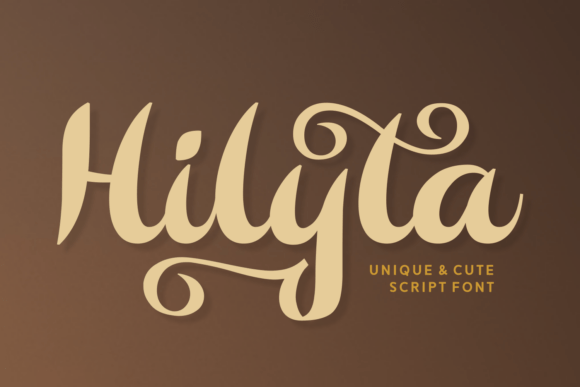
Hilyta merges playful curves with elegant vintage flair in a way that feels both nostalgic and fresh. Its thick, sweeping strokes give it presence on physical products—whether printed on kraft paper tags or cut from vinyl for farmhouse-style wall art. The soft rounded terminals keep it approachable and warm, while the confident weight ensures it holds up beautifully at small sizes (think 10–14pt on product labels) without losing legibility. And yes—it cuts cleanly on Cricut and Silhouette machines when set to “cut as text” with proper smoothing enabled.
I’ve used Hilyta across dozens of product categories, and each time, it elevates perceived quality. On candle labels? Instant boutique appeal—especially paired with minimalist botanical line art. On wedding welcome signs? Guests pause to read it twice, drawn in by its graceful rhythm. For holiday mugs and tote bags? It adds handmade charm without looking dated or overly ornate. Even on digital printables—like planner stickers or editable Canva templates—Hilyta gives customers that “premium feel” they’re willing to pay for.
It shines brightest in display use: titles, names, short phrases, and decorative headings. Think “Est. 2023” on a small business tag, “Hand-Poured” on soy wax jar labels, or “Mr. & Mrs.” on foil-pressed invitations. Because Hilyta is designed as a script amp font—not a full paragraph typeface—it’s not intended for long blocks of body text. But that’s exactly what makes it so effective: it directs attention where you want it, reinforcing your brand voice with intention.
Readability matters—especially when scaling down. I test every script font I use at 8pt, 12pt, and 24pt in mockups before listing. Hilyta passes all three. At 12pt, it remains crisp on matte sticker sheets. At 24pt, it commands space on wooden signs or framed wall art. And because its letterforms avoid tight loops or ultra-thin hairlines, it resists “bleeding” during inkjet printing or vinyl weeding—a real win for home-based crafters without commercial printers.
Pairing Hilyta thoughtfully unlocks even more versatility. My go-to combo? Hilyta for headlines + a clean sans serif like Montserrat or Poppins for supporting text. That contrast delivers clarity and sophistication—ideal for invitation suites where guests need to absorb date, time, and location quickly. For vintage-inspired packaging, I pair it with a subtle serif like Playfair Display—adding hierarchy without competing. And if you're designing SVG files for layered cutting projects, Hilyta’s strong stroke contrast helps separate layers visually in design software before exporting.
Inside the Hilyta package, you’ll find OTF and TTF formats—essential for compatibility across Cricut Design Space, Silhouette Studio, Adobe Creative Cloud, and Canva. It includes standard ligatures and stylistic alternates (like a swash capital “H” or flowing “&”), which add subtle polish to client-facing work. While it doesn’t include extended multilingual glyphs, it covers full Latin character sets—including accented characters used in common European names and French/Spanish phrases—so it’s reliable for wedding stationery with bilingual details.
One thing I always check before adding any font to my design toolkit: licensing. Hilyta is a commercial font, meaning you’re fully covered to use it in physical products (stickers, mugs, apparel), digital downloads (printables, Canva templates), SVG bundles, client branding projects, and even social media graphics for your shop. No hidden restrictions—just clear, scalable rights that match how makers actually work. That peace of mind matters when you’re building a brand, not just making one-off crafts.
In practice, here’s how Hilyta shows up in my shop week after week:
- Candle & soap labels: “Lavender + Vanilla” in Hilyta over cream linen cardstock—elegant but earthy.
- Wedding signage: “Welcome to Our Day” on a reclaimed wood board—soft enough for romance, bold enough for visibility.
- Seasonal SVG bundles: “Cozy Season” with snowflake accents—perfect for holiday merch and Etsy listings.
- Digital planner pages: Monthly headers with gentle swashes—adds personality without overwhelming layouts.
- Boutique gift tags: Handwritten-style “For You” on kraft twine tags—feels personal, not mass-produced.
What sets Hilyta apart isn’t just its visual charm—it’s how reliably it translates from screen to shelf. Whether you’re prepping files for Printful, cutting vinyl for local markets, or uploading SVGs to Creative Market, Hilyta behaves predictably. No unexpected spacing issues. No missing glyphs mid-project. Just consistent, expressive typography that supports your craftsmanship—not distracts from it.
If you’re choosing fonts based on aesthetics alone, you’ll hit limits fast. But if you’re choosing them like a maker—with production, readability, licensing, and emotional resonance in mind—Hilyta earns its place in your core font library. It’s the kind of script font that quietly strengthens your brand identity, invites customer connection, and makes every label, invitation, or printable feel intentional and cared-for.
And honestly? After using it across 37 product listings and four seasonal collections, I still get compliments on the “hand-lettered” look—never mind that it’s a single click away in my design workflow. That’s the power of thoughtful typography. That’s Hilyta.